


Beamsplitters
- Cylindrical Lenses
- Aspheric Lenses
- Achromatic Lenses
- Spherical Lenses
- Optical Prisms
- Optical Mirrors
- Beamsplitters
- Optical Windows
- Infrared Optics
- Micro Optics
- Optical Filters
- Colored Glass Filters
- Custom Shapes
- Laser Optics
- Freeform Optics
- Fresnel Lenses
- Light Pipe Homogenizing Rods
- TIR Lens
- Medical Device Optics
Custom Beamsplitters & Optical Beamsplitters
Shanghai Optics manufactures custom beamsplitters for laser, imaging, microscopy, interferometry and precision optical systems. Available designs include cube, plate, polarizing, non-polarizing, dichroic and wavelength-specific beamsplitters.
We can customize the substrate, wavelength range, transmission/reflection (T/R) ratio, polarization performance, angle of incidence, coating and mechanical dimensions to match your optical system. From prototype quantities to production, our engineers can support both individual optical components and beamsplitter assemblies.
Need a custom beamsplitter? Send us your wavelength, T/R ratio, polarization, AOI and dimensional requirements for review.
Custom Beamsplitter Manufacturing
Shanghai Optics supports custom beamsplitter development from optical specification and coating design through prototype and production. Designs can be tailored to the wavelength, polarization and mechanical requirements of the complete optical system.
Customizable Parameters
Operating wavelength or wavelength range
Transmission/reflection (T/R) ratio
Polarizing or non-polarizing performance
Angle of incidence (AOI)
Substrate material
Clear aperture and dimensions
Surface quality and flatness
Transmitted/reflected wavefront requirements
AR and beamsplitter coatings
Laser power requirements
Mechanical integration requirements
What to Send Us for a Custom Quote
For faster engineering review, provide as many of the following as available: wavelength, required T/R ratio, AOI, polarization state, beam diameter, optical power, substrate preference, dimensions and required optical tolerances.
Beamsplitter Options
| Type | Best For | Key Advantage |
| Cube Beamsplitters | Interferometry, imaging, compact optical systems | Easy alignment with minimal beam displacement |
| Plate Beamsplitters | Large apertures, lightweight systems | Lower weight and easier scaling to larger sizes |
| Polarizing Beamsplitters | Polarization control, laser systems | Separates s- and p-polarized light |
| Non-Polarizing Beamsplitters | Imaging, measurement and laser applications | Maintains similar splitting behaviour across polarization states |
| Dichroic Beamsplitters | Multi-wavelength imaging and spectral separation | Separates light by wavelength |
| Lateral Displacement Beamsplitters | Parallel-beam separation | Produces displaced parallel output beams |
Not sure which configuration fits your system? Our optical engineers can recommend a design based on wavelength, polarization, AOI, power and required T/R ratio.
Beamsplitter Types
Cube Beamsplitter
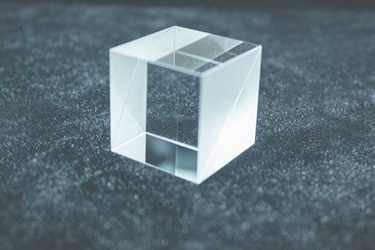
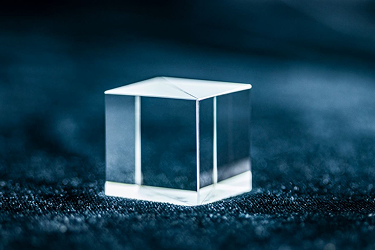
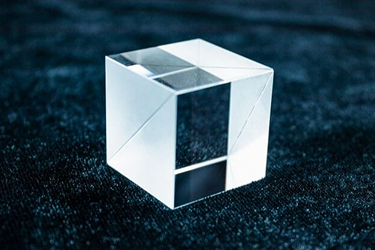
Cube beamsplitters combine two right-angle prisms with a partially reflective coating at the internal interface. Their compact geometry simplifies mounting and provides reflected and transmitted paths with minimal beam displacement, making them well suited to interferometry, imaging and precision optical instruments.
Custom cube beamsplitters can be designed for specific wavelengths, T/R ratios, polarization requirements and coatings. For higher-power applications, material, cement and coating selection should be considered as part of the optical design.
Cube beamsplitter diagram:
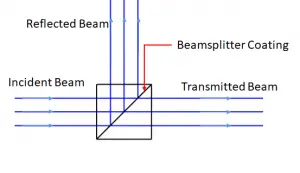
Plate Beamsplitter
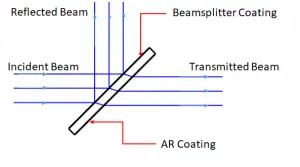
Plate beamsplitters use a coated optical substrate to divide incident light into reflected and transmitted paths. Compared with cube designs, they are lighter, easier to manufacture in larger apertures and often more cost-effective.
Because a plate introduces beam displacement in the transmitted path, substrate thickness, flatness, angle of incidence and coating performance should be considered during system integration. Shanghai Optics can customize plate beamsplitters for specific wavelengths, split ratios, polarization requirements and aperture sizes.
Plate beamsplitter diagram:
Polarizing Beamsplitters
Polarizing beamsplitters separate incident light according to polarization, typically transmitting p-polarized light while reflecting s-polarized light. Shanghai Optics offers custom polarizing cube, plate and lateral-displacement configurations for laser, imaging and polarization-control systems.
Non-Polarizing Beamsplitters
Non-polarizing beamsplitters divide incident light while minimizing sensitivity to the input polarization state. They are commonly used in imaging, interferometry, measurement and laser systems where consistent splitting performance is required for both s- and p-polarization.
Custom designs can be optimized for wavelength, T/R ratio, AOI, polarization dependence and laser power.
Dichroic Beamsplitters
Dichroic beamsplitters separate light by wavelength, transmitting one spectral region while reflecting another. They are commonly used in fluorescence imaging, microscopy, multispectral systems, laser systems and other applications requiring wavelength-selective beam separation or combination.
Important design parameters include:
- Transmission wavelength range
- Reflection wavelength range
- Transition edge
- Angle of incidence
- Polarization
- Required transmission/reflection efficiency
Laser Beamsplitters
Shanghai Optics designs and manufactures laser beamsplitters for specific laser wavelengths, power levels, polarization states and splitting ratios. Cube, plate and lateral-displacement configurations can be customised according to the optical architecture.
For laser applications, coating durability, surface quality, wavefront performance and laser-induced damage requirements can be considered alongside the required T/R ratio.
Tell us your laser wavelength, power, beam diameter, AOI, polarization and required split ratio to discuss a custom design.
Pellicle Beamsplitters
Pellicle beamsplitters use an ultra-thin membrane to minimize beam displacement, ghost reflections and optical path differences. They can be useful in interferometry, imaging and other applications where maintaining beam geometry is critical.
Because the membrane is mechanically delicate, pellicle beamsplitters are generally better suited to applications where their low beam displacement outweighs durability requirements.
Beamsplitter Glass & Substrate Materials
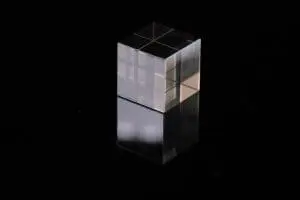
Beamsplitter glass is selected according to operating wavelength, laser power, environmental requirements and required optical performance. Shanghai Optics can manufacture beamsplitters using optical substrates including BK7-class optical glass, fused silica and other materials selected for UV, visible and infrared applications.
For demanding laser and imaging systems, substrate selection should be considered together with surface quality, flatness, coating performance, angle of incidence and transmitted wavefront requirements. Our engineers can recommend an appropriate glass and coating combination based on your application.
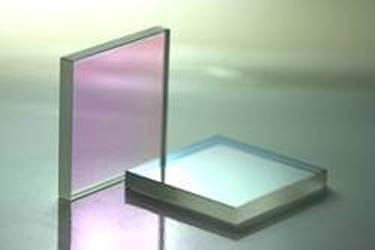


Custom Beam Splitting & Combining Solutions
Need a beam configuration beyond a standard beamsplitter?
Shanghai Optics can develop custom optical solutions for beam splitting and beam combining based on your system requirements. Our engineers can optimize the optical design, coatings and substrates for specific wavelengths, polarization states, transmission/reflection requirements and system geometries.
Custom solutions can support applications requiring multiple wavelengths or optical paths to be separated, directed or combined within a larger optical system.
Cube vs Plate Beamsplitters
| Consideration | Cube | Plate |
| Beam displacement | Minimal | Present in transmitted beam |
| Mounting | Generally easier | Requires careful alignment |
| Weight | Higher | Lower |
| Large apertures | More difficult/costly | Easier to manufacture |
| Optical path | Compact | May require more integration space |
| Typical selection driver | Stability & integration | Weight, aperture & cost |
The correct choice ultimately depends on wavelength, beam geometry, polarization, aperture, environmental requirements and system-level alignment tolerances.
Beamsplitter Integration Example: Multi-Channel Imaging
The Quad-Channel Imaging Optical System is a sophisticated example of advanced optical architecture designed to maximize the utility of high-precision beamsplitters. By integrating specialized beamsplitter assemblies, the system splits a single optical path into four independent channels, allowing for simultaneous data acquisition across a broad spectrum.
Key Features
- High Alignment Stability: Engineered to maintain optical axis consistency across all four channels, ensuring reliable data overlay for synchronized analysis.
- Broadband Coatings: Features high-performance coatings optimized for the 300 nm – 700 nm range, providing excellent throughput from UV to NIR.
- Low Stray Light: The internal housing and coating precision minimize internal reflections, preserving contrast in sensitive R&D environments.
- Matched Relay Paths: Carefully calibrated optical paths ensure that each channel delivers uniform magnification and focus.
System Specifications
| Parameter | Specification |
| Operating Spectral Range | 300 nm – 700 nm |
| Field-of-View (FOV) Consistency | ≥ 99.5% |
| Illumination Uniformity Deviation | ≤ 5% |
Typical Applications
This beam-split multi-channel imaging system is essential for capturing transient phenomena where standard sensors cannot keep pace. Typical use cases include:
- Ultrafast Imaging & Material Dynamics: Observing rapid structural changes or shockwave propagation.
- Combustion Diagnostics: Analyzing flame chemistry and temperature distribution in real-time.
- Ballistic Impacts: High-resolution capture of high-velocity events.
- Microfluidics: Tracking particles or fluid flow in complex microscopic environments.
Frequently Asked Questions
Key specifications include the operating wavelength or spectral range, transmission/reflection (T/R) ratio, angle of incidence (AOI), polarization state, clear aperture, substrate, surface quality, flatness, and transmitted/reflected wavefront requirements. For laser systems, beam diameter, power or energy density, pulse characteristics, and applicable laser-damage requirements should also be defined.
The required transmission/reflection ratio should be specified at the operating wavelength or spectral range and under the intended AOI and polarization conditions. For broadband or polarization-sensitive systems, performance may vary across wavelength, AOI, and s- and p-polarization, so acceptable tolerances should be defined around actual system requirements.
Beamsplitter coating performance is dependent on wavelength, AOI, and polarization. At non-normal incidence, s- and p-polarized light can exhibit different transmission and reflection characteristics. The nominal AOI, angular range, polarization state, and required spectral performance should therefore be considered together during coating design.
Cube beamsplitters are often preferred when compact integration, mechanical stability, and minimal transmitted-beam displacement are important. Plate beamsplitters offer lower weight and greater flexibility for larger apertures but introduce lateral displacement and can require additional consideration of ghost reflections and wavefront effects. Selection should be based on the complete optical layout rather than form factor alone.
In addition to wavelength and T/R ratio, laser applications may require consideration of polarization, beam diameter, CW power or pulse energy, pulse duration and repetition rate, coating absorption, surface quality, wavefront performance, and laser-induced damage threshold (LIDT). These requirements can influence both substrate and coating selection.
Substrate selection should consider spectral transmission, refractive index, thermal properties, homogeneity, environmental durability, achievable surface quality and flatness, and coating compatibility. Fused silica may be preferred for demanding laser or thermal applications, while optical glasses can be appropriate for many visible and NIR systems depending on performance requirements.
Broadband and multi-wavelength designs require the desired T/R performance to be defined across each operating spectral region, together with AOI and polarization conditions. Wider spectral coverage, tighter T/R tolerances, and polarization-insensitive requirements can increase coating complexity, so these parameters should be evaluated together during design.
For an efficient engineering review, provide the wavelength or spectral range, target T/R ratio and tolerance, AOI, polarization state, clear aperture, substrate preference, dimensions, surface quality, flatness and wavefront requirements, quantity, and operating environment. For laser applications, include beam diameter and relevant CW or pulsed laser parameters. An optical drawing or target spectral curve can also be provided when available.
Need a Custom Beamsplitter?
Shanghai Optics can support custom beamsplitter development from coating and substrate selection through prototype and production.
Send us your: Wavelength • T/R Ratio • AOI • Polarization • Beam Size • Power • Dimensions • Optical Tolerances
Our optical engineering team can review your requirements and recommend a suitable cube, plate, polarizing, non-polarizing or wavelength-selective solution.
Need help?
We offer consultations and initial feasibility studies. If you have questions about limitations or lens capabilities we’re more than happy to work through your proposed custom components. As an unmatched custom optical provider, we’ll do everything that we can bring your vision to life.


