


Customizing Quantum Photonics Optical Components
How to customize your optical components for your quantum photonics application
In the rapidly evolving field of quantum photonics, customizing optical components to fit specific applications is crucial for success. Whether you’re working with quantum sensors or other quantum optical technologies, tailoring these components can enhance performance and lead to groundbreaking innovations.
Understanding Quantum Photonics Optical Components
Quantum photonics involves the use of light to control and manipulate quantum information. This field leverages the unique properties of photons, like superposition and entanglement, to develop advanced technologies. Optical components for quantum technologies are essential because they guide, filter, and manipulate light in precise ways.
The Role of Quantum Optics
Quantum optics is the study of how photons interact at the quantum level. Understanding these interactions is vital for customizing optical components. Quantum optics forms the backbone of many quantum technologies, including quantum computing, quantum communication, and quantum sensing.
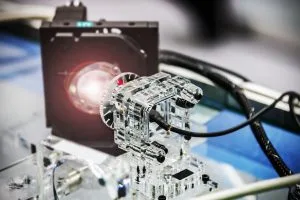
The Importance of Customizing Optical Components
Customization allows you to tailor optical components to the specific requirements of your application. Off-the-shelf components might not meet the precise demands needed for cutting-edge quantum technologies. Customization ensures optimal performance and can significantly impact the success of your quantum photonics application.
Key Benefits of Customization
- Precision and Accuracy: Custom optical components can be designed to achieve the exact specifications needed for your application, ensuring high precision and accuracy.
- Enhanced Performance: By tailoring components to your needs, you can enhance the performance and efficiency of your quantum photonics system.
- Innovation and Flexibility: Customization opens doors to innovative designs and flexible solutions, allowing you to experiment and push the boundaries of what’s possible in quantum photonics.
High-NA UV Microscope Objectives for Trapped Ion Systems
Shanghai Optics has successfully developed specialized UV microscope objectives tailored for the rigorous demands of quantum photonics. A standout project involved creating a lens system specifically optimized for trapped ion experimental systems, where high light collection and physical clearance are both critical.
The Engineering Challenge:
In standard microscopy, high light collection usually requires the lens to be nearly touching the sample. However, in quantum research, optics must often perform through vacuum chamber windows. Our team engineered a solution that maintains a High Numerical Aperture (NA ≥ 0.48) while providing an exceptionally long working distance of ≥ 50 mm—a breakthrough that allowed for diffraction-limited UV imaging without physical interference with the experimental setup.
Key Technical Specifications:
- Wavelength Precision Working Wavelengths: 397 nm, 400 nm, and 632.8 nm
- Maximum Light Collection: Numerical Aperture (NA): ≥ 0.48, essential for low-signal quantum imaging.
- Exceptional Accuracy: Wavefront Error ≤ RMS 05λ @ 632.8nm with Telecentricity < 5 mrad.
- Optimized Throughput: Transmission rates : ≥ 92% across the target spectra.
Steps to Customize Your Optical Components
- Identify Your Needs: Define wavelength, environment, and physical constraints.
- Choose the Right Materials: Select substrates for high transparency and low absorption.
- Design & Simulation: Utilize optical designers to model lenses and filters.
- Prototype and Test: Verify diffraction-limited performance in real-world conditions.
- Expert Collaboration: Work with manufacturers specializing in quantum photonics optics.
Real-World Applications
Quantum Sensors: Achieving high sensitivity for medical imaging and defense.
Quantum Computing: Manipulating qubits for scalable, high-speed systems.
Quantum Communication: Securing data transmission via photon state manipulation.
Overcoming Challenges in Customizing Optical Components
While customization offers significant performance advantages, it also presents unique engineering obstacles. Shanghai Optics utilizes a systematic approach to address these common industry challenges:
- Technical Complexity: Customizing optics for quantum applications requires a deep understanding of quantum optics. We work closely with your team to provide the technical support needed to navigate complex specifications like diffraction-limited UV imaging.
- Cost Considerations: While custom designs can have higher initial costs than off-the-shelf parts, the long-term benefits—such as improved system efficiency and competitive advantage—often outweigh the investment. We focus on cost-effective optical solutions without compromising on precision.
- Keeping Up with Rapid Advances: The field of quantum photonics is moving fast. Our engineers stay at the forefront of the latest trends, ensuring your application remains cutting-edge and compatible with future technological shifts.
Conclusion
Customizing optical components for your quantum photonics application is a crucial step in achieving optimal performance and innovation. By understanding the principles of quantum optics, identifying your specific needs, and collaborating with experts, you can create components that push the boundaries of what’s possible.
As quantum technologies continue to evolve, the importance of tailored solutions—like High-NA UV objectives—will only grow. Whether you’re developing quantum sensors, computing systems, or communication networks, customized optical components will play a key role in your success.
Contact Shanghai Optics today! We’d be more than happy to discuss your quantum projects and how to best bring them to fruition.


