

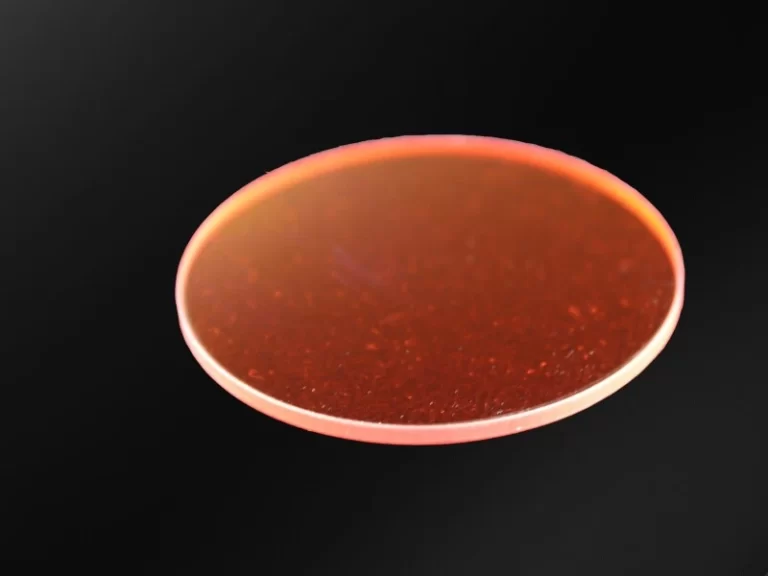
Dichroic Filter
A dichroic filter is a thin optical filter crafted to transmit light in only one narrowly defined wavelength band while reflecting all other wavelengths. These optical filters are also known as thin-film or interference filters.
Dichroic filters are typically placed at a 45-degree angle to a light source. With this placement, blocked light is reflected at a 90-degree angle while specified wavelengths of light pass through the filter. If a light source is emitting white light, the light filtered through a filter of this type will seem to be highly saturated in color. A red filter, for instance, will transmit red wavelengths and reflect cyan. A green filter will transmit green and reflect magenta.
Longpass Dichroic Filters
| Substrate | Optical-Grade Float Glass (B270) |
| Transmitted Wavefront Error | λ/4@633nm |
| Parallelism | <30 arcsec |
| Surface Quality | 40-20 |
| Dimension Tolerance | +0.0/-0.1mm |
| Thickness | 2mm ±0.2mm |
| Cut-On Tolerance | ±10nm |
| Transmission | Tavg>90% |
| Reflection | Ravg>98% |
| Clear Aperture | >90% |
| Angle of Incidence | 45° |
| Cut-On Wavelength (nm) | Reflection Band (nm) | Transmission Band (nm) | Part Number | Request Quote |
|---|---|---|---|---|
| 425 | 370-400 | 440-1200 | SO-DIC-FIL-EE12C-0001 | Request a Quote |
| 450 | 370-430 | 465-1200 | SO-DIC-FIL-EE12C-0002 | Request a Quote |
| 500 | 370-480 | 515-1200 | SO-DIC-FIL-EE12C-0003 | Request a Quote |
| 550 | 385-520 | 565-1200 | SO-DIC-FIL-EE12C-0004 | Request a Quote |
| 600 | 460-570 | 620-1200 | SO-DIC-FIL-EE12C-0005 | Request a Quote |
| 650 | 495-615 | 670-1200 | SO-DIC-FIL-EE12C-0006 | Request a Quote |
| 700 | 535-665 | 720-1200 | SO-DIC-FIL-EE12C-0007 | Request a Quote |
| 750 | 565-715 | 770-1200 | SO-DIC-FIL-EE12C-0008 | Request a Quote |
| 800 | 600-760 | 820-1200 | SO-DIC-FIL-EE12C-0009 | Request a Quote |
| 850 | 635-810 | 870-1200 | SO-DIC-FIL-EE12C-0010 | Request a Quote |
Shortpass Dichroic Filters
| Substrate | Optical-Grade Float Glass (B270) |
| Transmitted Wavefront Error | λ/4@633nm |
| Parallelism | <30 arcsec |
| Surface Quality | 40-20 |
| Dimension Tolerance | +0.0/-0.1mm |
| Thickness | 2mm ±0.2mm |
| Cut-Off Tolerance | ±10nm |
| Transmission | Tavg>90% |
| Reflection | Ravg>98% |
| Clear Aperture | >90% |
| Angle of Incidence | 45° |
| Cut-Off Wavelength (nm) | Transmission Band (nm) | Reflection Band (nm) | Part Number | Request Quote |
|---|---|---|---|---|
| 450 | 370-430 | 470-545 | SO-DIC-FIL-EE12C-0011 | Request a Quote |
| 500 | 370-480 | 520-610 | SO-DIC-FIL-EE12C-0012 | Request a Quote |
| 550 | 400-530 | 575-725 | SO-DIC-FIL-EE12C-0013 | Request a Quote |
| 600 | 400-580 | 625-795 | SO-DIC-FIL-EE12C-0014 | Request a Quote |
| 650 | 400-630 | 675-850 | SO-DIC-FIL-EE12C-0015 | Request a Quote |
| 700 | 400-680 | 725-900 | SO-DIC-FIL-EE12C-0016 | Request a Quote |
| 750 | 400-725 | 800-990 | SO-DIC-FIL-EE12C-0017 | Request a Quote |
| 800 | 400-775 | 850-1050 | SO-DIC-FIL-EE12C-0018 | Request a Quote |
| 850 | 400-820 | 910-1110 | SO-DIC-FIL-EE12C-0019 | Request a Quote |
A dichroic filter is an optical filter that selectively transmits specific wavelengths while reflecting others using thin-film interference coatings. Unlike absorptive filters, dichroic filters separate light through reflection and transmission, resulting in higher efficiency and minimal energy loss.
Dichroic filters are widely used in fluorescence microscopy, laser systems, multispectral imaging, biomedical instrumentation, flow cytometry, and machine vision. Their ability to precisely separate wavelengths makes them essential components in optical systems requiring accurate spectral control.
How Does a Dichroic Filter Work?
Dichroic filters utilize multiple dielectric thin-film layers deposited on an optical substrate. These layers create constructive and destructive interference effects that determine which wavelengths are transmitted and which are reflected.
When white light strikes the filter at a specified angle of incidence, selected wavelengths pass through the filter while unwanted wavelengths are reflected away from the optical path.
Key performance factors include:
- Cut-on wavelength
- Cut-off wavelength
- Angle of incidence
- Polarization sensitivity
- Reflection and transmission efficiency
This optical mechanism allows dichroic filters to achieve extremely sharp spectral transitions and high transmission performance.
Dichroic Filters for Every Application
A dichroic filter is a thin optical filter crafted to transmit light in only one narrowly defined wavelength band while reflecting all other wavelengths. These optical filters are also known as thin-film or interference filters.
Dichroic filters are typically placed at a 45-degree angle to a light source. With this placement, blocked light is reflected at a 90-degree angle while specified wavelengths of light pass through the filter. If a light source is emitting white light, the light filtered through a filter of this type will seem to be highly saturated in color. A red filter, for instance, will transmit red wavelengths and reflect cyan. A green filter will transmit green and reflect magenta.
Shanghai Optics manufactures high-quality dichroic filters in longpass, shortpass, bandpass, bandblocking, and color correction types. These filters are carefully crafted to exact specifications, and since the color is intrinsically part of the filter, it will not bleach out. This gives our filters a much longer useful life than other conventional filters. Our dichroic filters also have a very high laser damage threshold.
Applications of Dichroic Filters
- Fluorescence Microscopy: Dichroic filters separate excitation and emission wavelengths, allowing fluorescence signals to be captured with high contrast and minimal background noise.
- Flow Cytometry: Multiple dichroic filters enable simultaneous detection of different fluorophores for advanced cell analysis.
- Laser Systems: Dichroic filters combine or separate laser wavelengths with minimal optical loss.
- Biomedical Imaging: Used in diagnostic instruments and spectroscopy systems requiring precise wavelength management.
- Machine Vision: Support color separation and multispectral inspection systems for industrial automation.
Types of Dichroic Filters
- Longpass Filters: Longpass dichroic filters transmit wavelengths above a specified cut-on wavelength while reflecting shorter wavelengths. These filters are commonly used in fluorescence microscopy and laser applications.
- Shortpass Filters: Shortpass dichroic filters transmit wavelengths below a specified cut-off wavelength while reflecting longer wavelengths. They are frequently used for wavelength separation and heat management.
- Bandpass Filters: Bandpass dichroic filters isolate a narrow wavelength range while rejecting wavelengths outside the passband. These filters are widely used in spectroscopy, fluorescence imaging, and optical sensing.
Dichroic Filter vs Dichroic Mirror
Although the terms are often used interchangeably, their applications may differ.
Feature | Dichroic Filter | Dichroic Mirror |
Primary Function | Wavelength filtering | Wavelength reflection |
Optical Configuration | Filter systems | Imaging systems |
Common Applications | Microscopy, spectroscopy | Projection, illumination |
Spectral Separation | Yes | Yes |
In practice, both utilize multilayer dielectric coatings to separate wavelengths with high efficiency.
Shanghai Optics Dichroic Filters
Our state-of-the-art dichroic filters feature a sharp transition from reflection to transmission. They also exhibit high transmission in the pass band. All of our filters are dielectric coated with IBS technology. We use hard coatings and no adhesives to improve the filters’ lifespan. These hard coatings provide good resistance to abrasion and temperature.
Our factory standard dichroic features are manufactured from UV-grade fused silica. They have an operating temperature from -45°C to about 85°C, and an angle of incidence of 45.0°. Our thickness tolerance limits are ±0.1 mm, and each of our filters has a clear aperture of at least 95%. Our standard dichroic filters are 25.2 mm by 35.6 mm by 1.1 mm.
We can also manufacture custom dichroic filters tailored to your specific needs. Our expert team will guide you through the design, prototyping, and production stages, ensuring that your custom filters are optimized for transmitted and reflected wavelengths and are designed for high-power optical systems. Please contact us to schedule a consultation or request a quote for your next project.
Key Features
- Sharp transition from reflection to transmission
- High transmission in pass band
- Hard coatings and no adhesives for long filter life span
- All dielectric coated with IBS technology
- Durable design for high-power applications
Why Choose Shanghai Optics Dichroic Filters?
Shanghai Optics manufactures high-performance dichroic filters using Ion Beam Sputtering (IBS) technology for superior coating durability and optical performance.
Benefits include:
- Sharp spectral transitions
- High transmission efficiency
- Excellent environmental durability
- High laser damage thresholds
- Custom wavelength designs
- Long service life without adhesive degradation
These features make our filters suitable for demanding scientific, industrial, and biomedical applications.
Factory Standard
- Angle of Incidence: 45.0°
- Shortpass Type Transmittance: Tabs>85%
- Dimensions: 25.2 mm x 35.6 mm x 1.1 mm
- Clear Aperture: >95%
- Operating Temperature: -45°C ~ 85°C
- Physical Durability: MIL-C-48497A
- Longpass Type Transmittance: Tabs>90%
- Reflection Band: Rabs>98%
- Thickness Tolerance: ±0.1 mm
- Transmitted Wavefront: 1/4λ RMS@633nm (per inch)
- Environmental Durability: MIL-STD-810F
- Substrate: UV Grade Fused Silica
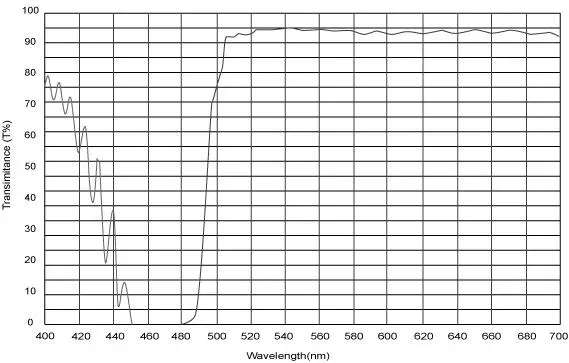
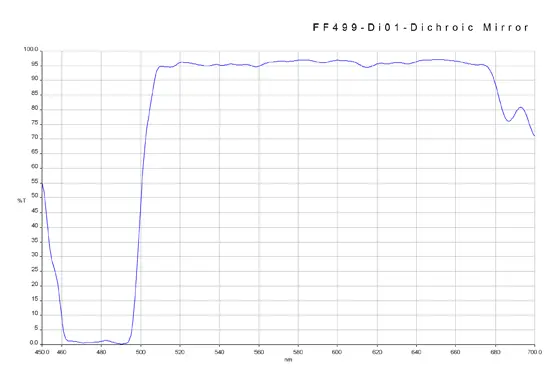
Custom Dichroic Filter Manufacturing
Shanghai Optics offers custom dichroic filter design and manufacturing services.
Customization options include:
- Custom wavelength ranges
- Longpass, shortpass, and bandpass designs
- Custom dimensions
- High-power laser coatings
- UV, VIS, NIR, and SWIR optimization
- Custom angles of incidence
Our engineering team works closely with customers to develop filters optimized for their specific optical systems.
Contact us for manufacturing limit or custom specifications.
Frequently Asked Questions
What is a dichroic filter?
A dichroic filter is an optical filter that transmits selected wavelengths while reflecting others using thin-film interference coatings.
How does a dichroic filter work?
Dichroic filters use multiple dielectric coating layers to create wavelength-selective reflection and transmission.
What is the difference between a dichroic filter and a dichroic mirror?
Both use similar coating technology, but dichroic filters are generally used for wavelength filtering while dichroic mirrors are commonly used for wavelength reflection and beam steering.
What are dichroic filters used for?
Applications include fluorescence microscopy, flow cytometry, laser systems, spectroscopy, machine vision, and biomedical imaging.
Can dichroic filters be customized?
Yes. Dichroic filters can be customized for wavelength range, coating design, dimensions, substrate material, and angle of incidence.
Dichroic Longpass Filter
| Cut-off Wavelength(nm) | Reflection Band(nm) | Transmission Band(nm) | Size(mm) |
| 411 | 344-404 | 415-570 | 25.2*35.6*1.1 |
| 458 | 426-450 | 467-600 | 25.2*35.6*1.1 |
| 497 | 442-488 | 502-730 | 25.2*35.6*1.1 |
| 508 | 446-500 | 513-725 | 25.2*35.6*1.1 |
| 520 | 488-512 | 528-655 | 25.2*35.6*1.1 |
| 555 | 493-548 | 562-745 | 25.2*35.6*1.1 |
| 565 | 499-555 | 569-730 | 25.2*35.6*1.1 |
| 595 | 530-585 | 601-800 | 25.2*35.6*1.1 |
| 655 | 470-645 | 665-726 | 25.2*35.6*1.1 |
| 660 | 594-651 | 669-726 | 25.2*35.6*1.1 |
| 665 | 350-650 | 680-1100 | 25.2*35.6*1.1 |
| 669 | 350-660 | 677-800 | 25.2*35.6*1.1 |
| 735 | 350-720 | 750-1100 | 25.2*35.6*1.1 |
| 740 | 480-720 | 750-825 | 25.2*35.6*1.1 |
Dichroic Shortpass Filter
| Cut-off Wavelength(nm) | Transmission Band(nm) | Reflection Band(nm) | Size(mm) |
| 550 | 400-548 | 575-725 | 25.2*35.6*1.1 |
| 600 | 400-580 | 625-795 | 25.2*35.6*1.1 |
| 700 | 400-680 | 725-900 | 25.2*35.6*1.1 |
| 750 | 400-725 | 800-990 | 25.2*35.6*1.1 |
| 800 | 400-775 | 850-1050 | 25.2*35.6*1.1 |
| 850 | 400-820 | 910-1110 | 25.2*35.6*1.1 |
| 900 | 425-865 | 960-1170 | 25.2*35.6*1.1 |
| 950 | 450-910 | 1025-1235 | 25.2*35.6*1.1 |
| 1000 | 465-940 | 1085-1305 | 25.2*35.6*1.1 |
| 1050 | 485-1000 | 1130-1370 | 25.2*35.6*1.1 |
Need help?
We offer consultations and initial feasibility studies. If you have questions about limitations or lens capabilities we’re more than happy to work through your proposed custom components. As an unmatched custom optical provider, we’ll do everything that we can bring your vision to life.


